Music Attribution Scaffold
Open-source research scaffold for music attribution with transparent confidence scoring.
Companion code to: Teikari, P. (2026). Governing Generative Music: Attribution Limits, Platform Incentives, and the Future of Creator Income. SSRN No. 6109087.
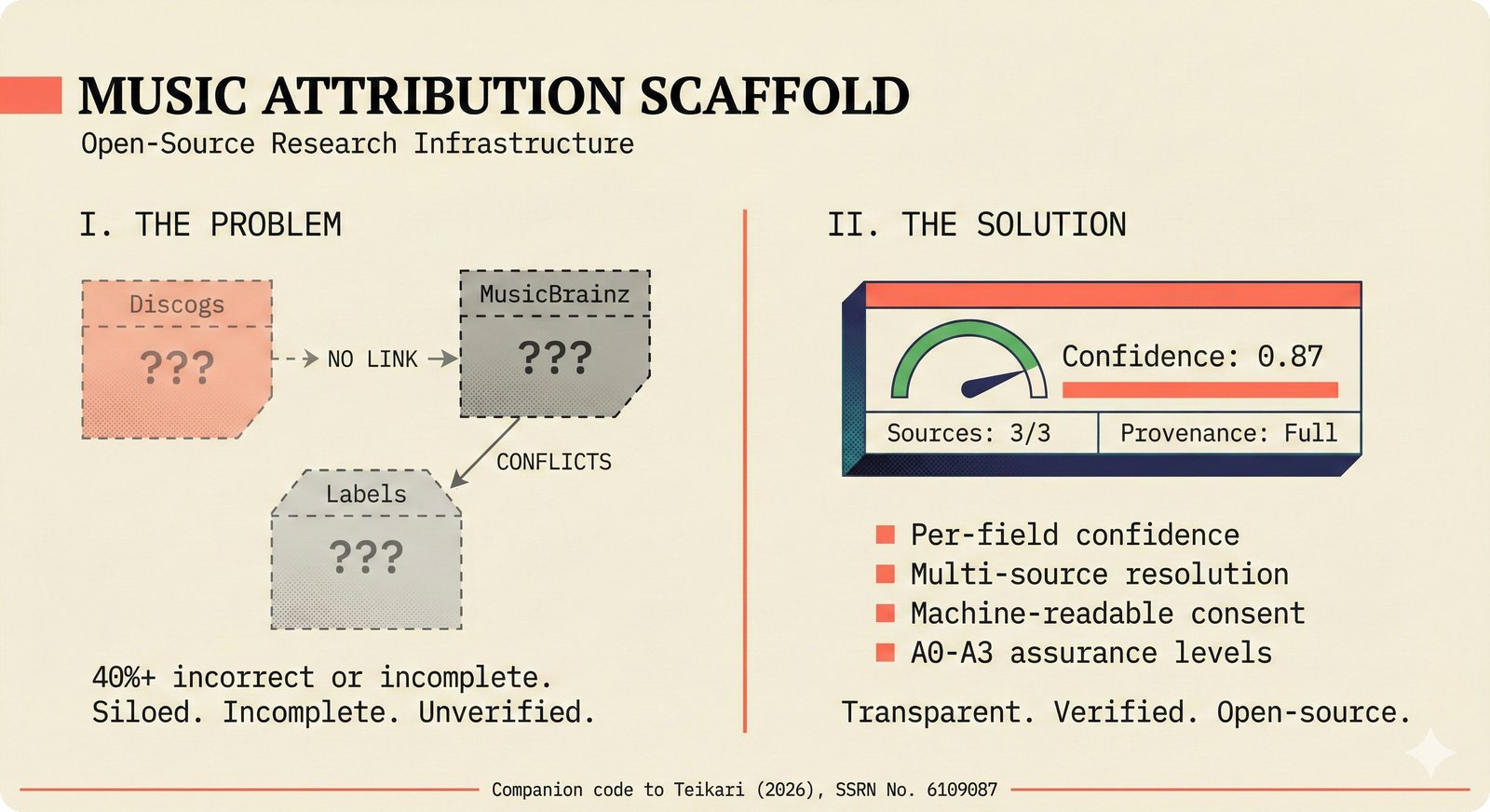
What is This?
Music Attribution Scaffold is a research framework that demonstrates how to build a multi-source music attribution system with:
- Per-field confidence scores — not just "is this correct?" but "how confident are we, and why?"
- Entity resolution across messy sources — reconciling MusicBrainz, Discogs, AcoustID, and file metadata
- AI-ready permissions via MCP — machine-readable consent infrastructure for the generative AI era
Research Scaffold, Not Production System
This repo demonstrates concepts from the SSRN preprint. It is designed to be forked, extended, and adapted — not deployed as-is.
The Pipeline
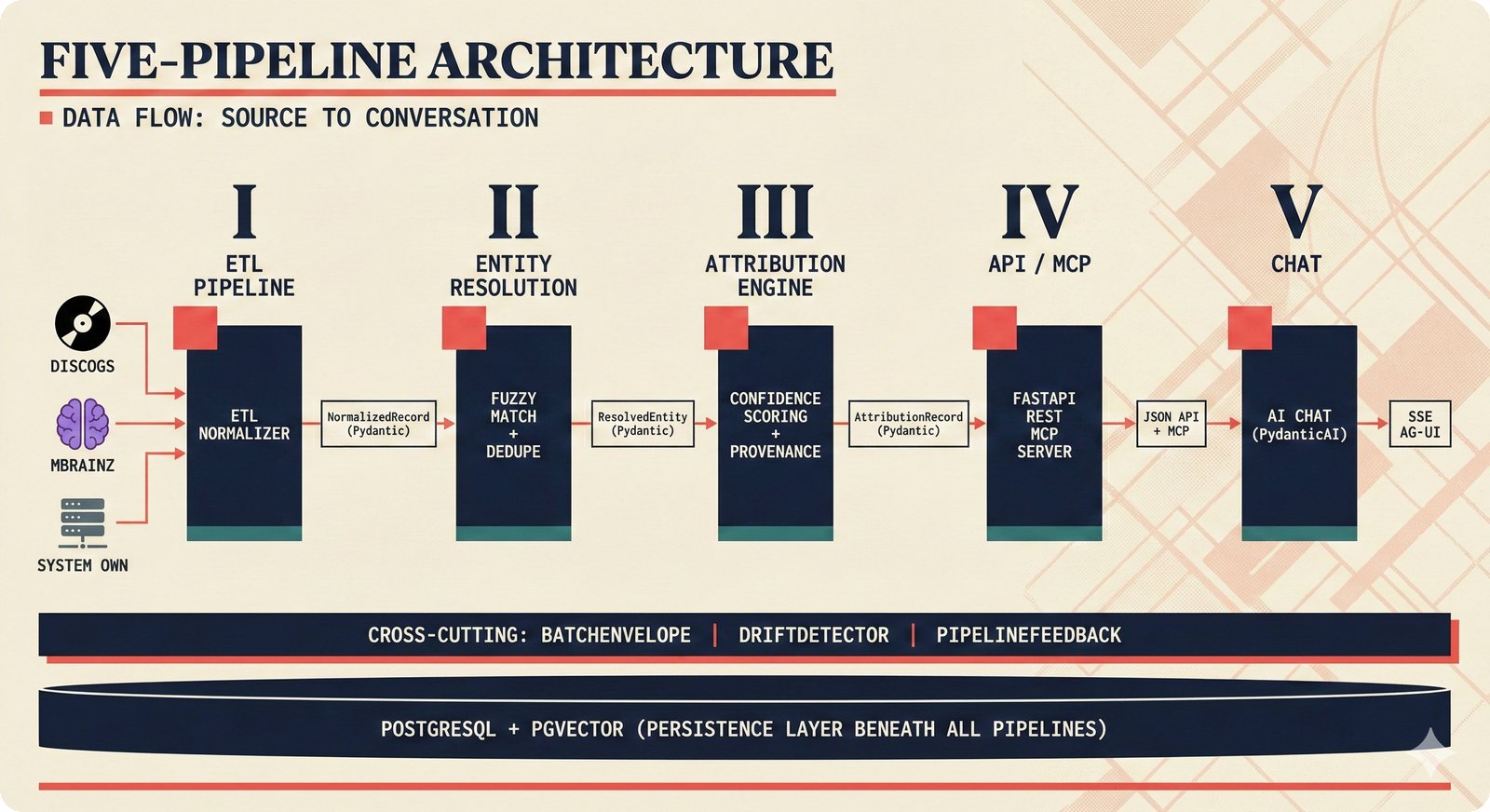
The five-pipeline architecture: data flows from ETL through entity resolution and attribution scoring to API/MCP endpoints and the agentic chat interface.
Pipeline diagram (Mermaid)
graph LR
    A[ETL<br/>5 sources] --> B[Entity<br/>Resolution]
    B --> C[Attribution<br/>Engine]
    C --> D[API / MCP<br/>Server]
    D --> E[Chat Agent<br/>+ Frontend]

    style A fill:#e1f5fe
    style B fill:#e1f5fe
    style C fill:#fff3e0
    style D fill:#e8f5e9
    style E fill:#e8f5e9
Quick Start
git clone https://github.com/petteriTeikari/music-attribution-scaffold.git
cd music-attribution-scaffold
make setup        # Install deps + start PostgreSQL
make agent &      # Start FastAPI backend on :8000
make dev-frontend # Start Next.js frontend on :3000
Open http://localhost:3000 to see 9 Imogen Heap attribution records with confidence scoring.
Quick Links
-
Getting Started
Install and run the scaffold in under 5 minutes
-
Key Concepts
Understand the Oracle Problem, assurance levels, and two-friction taxonomy
-
API Reference
Auto-generated documentation from source code
-
Reproduce the Paper
Map every paper claim to code, tests, and demo commands
Sample Data
The scaffold ships with 9 Imogen Heap works spanning the full confidence range:
| Work | Confidence | Assurance | Needs Review |
|---|---|---|---|
| Hide and Seek | 0.95 | A3 | No |
| Tiny Human | 0.91 | A3 | No |
| The Moment I Said It | 0.82 | A2 | No |
| Goodnight and Go | 0.72 | A2 | No |
| Headlock | 0.58 | A1 | Yes |
| What Have You Done To Me? | 0.48 | A1 | Yes |
| Just for Now | 0.35 | A1 | Yes |
| 2-1 | 0.28 | A1 | Yes |
| Blanket | 0.00 | A0 | Yes |
Technology Stack
| Layer | Technology | Why |
|---|---|---|
| Backend | Python 3.13, FastAPI, SQLAlchemy | Async-first, type-safe, Pydantic integration |
| Database | PostgreSQL + pgvector | Relational + vector search in one database |
| Agent | PydanticAI, AG-UI protocol | Type-safe tools, SSE streaming, FallbackModel |
| Frontend | Next.js 15, Tailwind v4, CopilotKit | App Router, editorial design system |
| State | Jotai | Atomic state, no boilerplate |
| Analytics | PostHog | Privacy-first, typed events |
| MCP | Model Context Protocol | Machine-readable permission queries |
Citation
@article{teikariGoverningGenerativeMusic2026,
    title = {Governing Generative Music: Attribution Limits, Platform Incentives, and the Future of Creator Income},
    url = {https://doi.org/10.2139/ssrn.6109087},
    doi = {10.2139/ssrn.6109087},
    publisher = {Social Science Research Network},
    author = {Teikari, Petteri},
    year = {2026},
}
License
MIT. All dependencies verified MIT/Apache/BSD compatible.