Assurance Levels (A0--A3)
Four tiers of verification depth -- from "someone said so" to "forensically verified with identity-checked sources."
The Simple Version
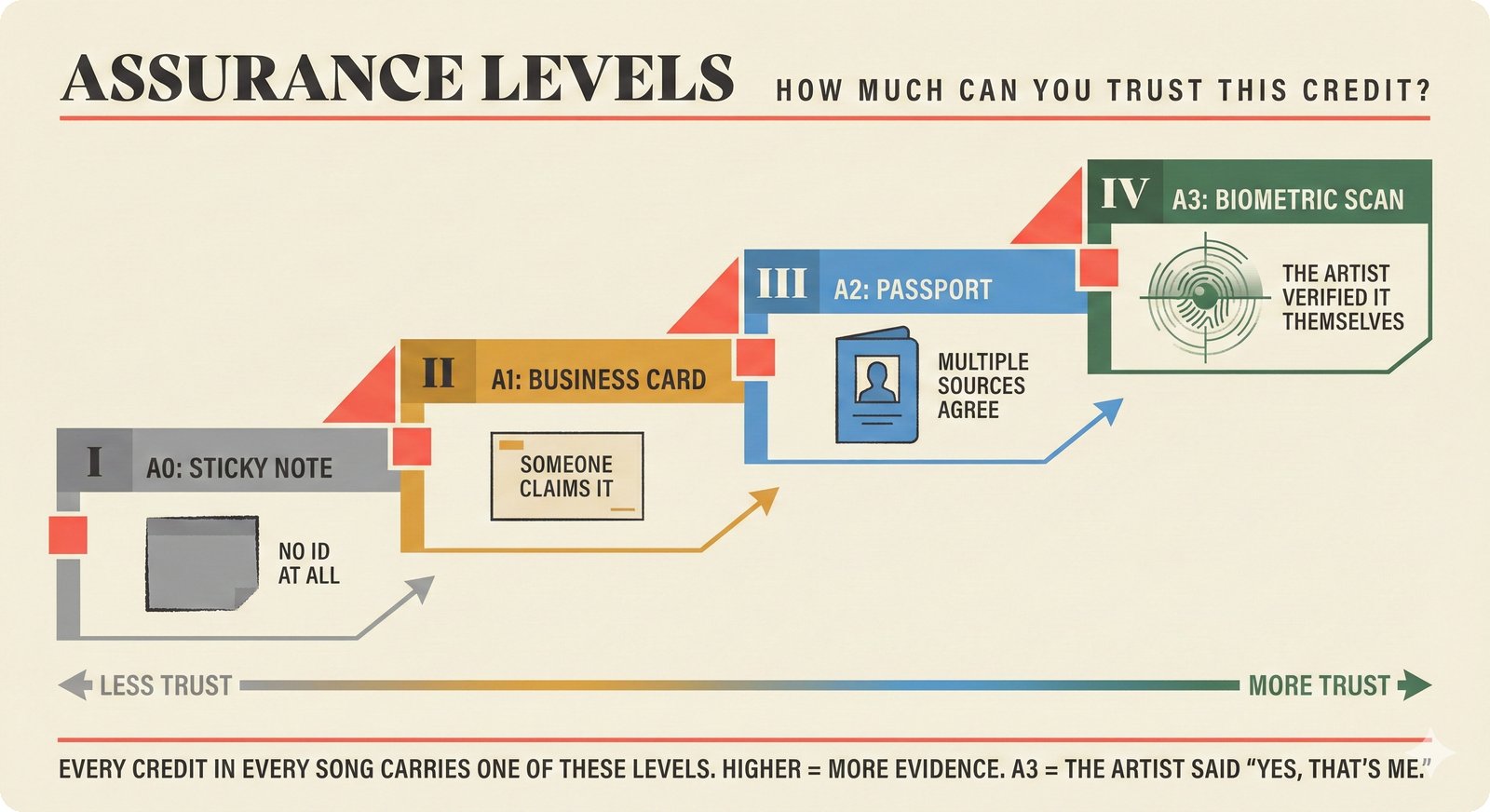
Figure 5. Assurance levels A0-A3 explained through everyday ID card analogies: every attribution claim carries a trust level from no data (A0) to artist-verified (A3), enabling music industry professionals to assess how much evidence supports each music credit.
Think of different forms of identification:
| Level | Real-World Analogy | Trust Level |
|---|---|---|
| A0 | Someone tells you their name verbally | "I'll take your word for it" |
| A1 | They show you a library card | "I see some documentation" |
| A2 | They show a government-issued passport | "Multiple authorities agree" |
| A3 | Passport + biometric scan + background check | "Forensically verified" |
Music attribution works the same way. When someone claims "I wrote this song," how much evidence backs that claim? A0 means no evidence at all -- just a claim in a file tag. A3 means multiple independent databases agree, and the person has a verified industry identity (ISNI).
The higher the assurance level, the more sources agree and the harder the evidence is to forge.
For Music Industry Professionals
What Each Level Means in Practice
The attribution comes from a single, unverified source -- typically file metadata (ID3 tags) or a user's own claim.
Real-world example: An MP3 file has "Artist: Imogen Heap" in its ID3 tag, but no ISRC, no MusicBrainz match, no Discogs entry. Someone typed that text -- it could be correct, or it could be a mislabeled file.
Trust signal: None beyond the claim itself.
At least one standard industry identifier (ISRC, ISWC, or MBID) is present, but only from a single source.
Real-world example: The track has a valid ISRC code (GBAYE0200774), which links to a single entry in a rights database. No second source confirms it.
Trust signal: One identifier from one database.
Multiple independent sources agree on the attribution, and at least one standard identifier is present.
Real-world example: MusicBrainz and Discogs both list Imogen Heap as the performer of "Hide and Seek" (ISRC: GBAYE0200774). The ISRC appears in both databases independently.
Trust signal: Cross-source agreement plus identifiers.
Everything in A2, plus the artist has a verified identity (ISNI) and multiple sources confirm it.
Real-world example: Imogen Heap has ISNI 0000 0001 2140 6981. MusicBrainz, Discogs, and ISNI records all cross-reference consistently. The identity chain is verifiable.
Trust signal: Identity-verified, multi-source, with standard identifiers.
Industry Identifier Mapping
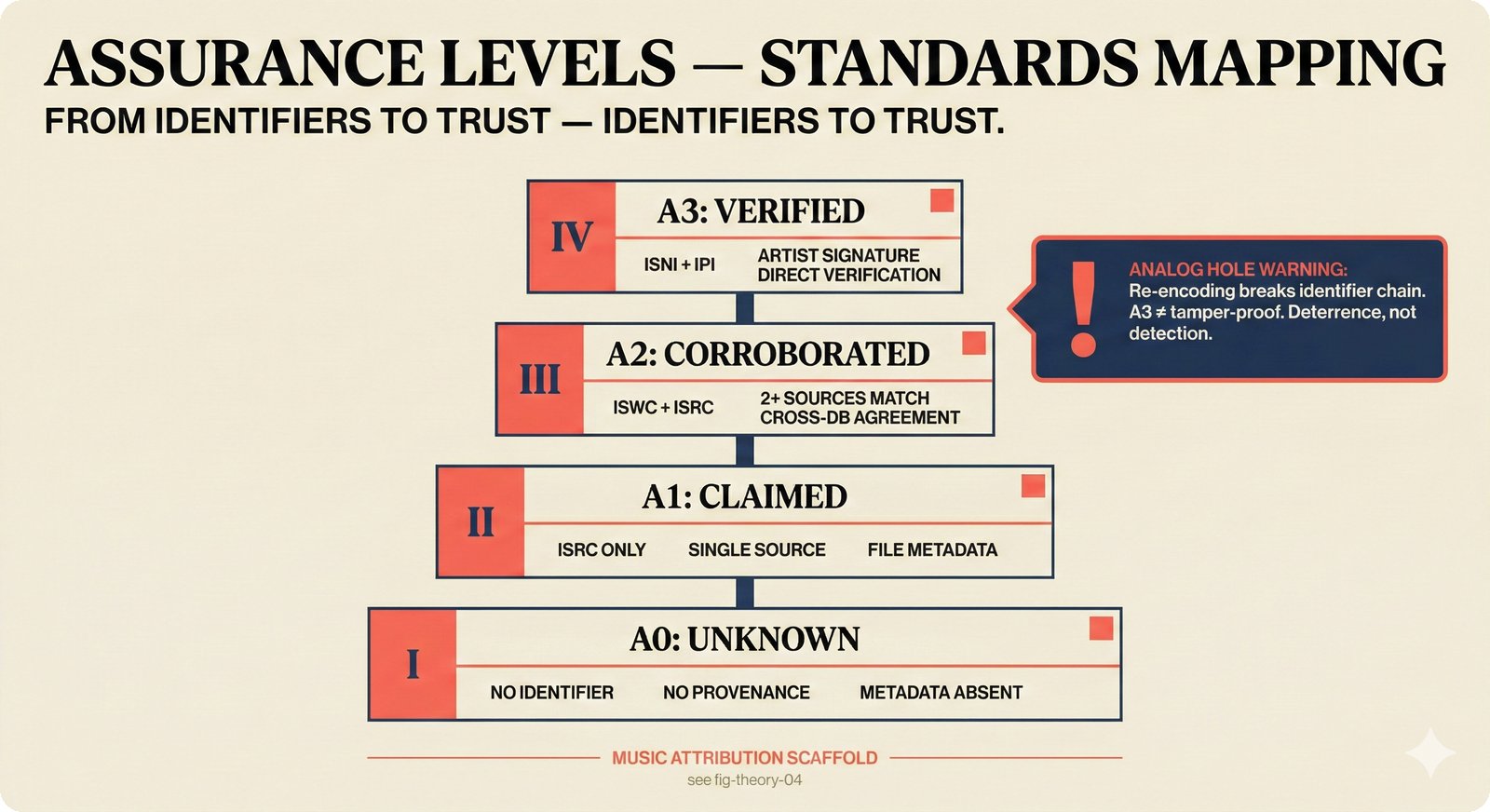
Figure 6. Assurance levels mapped to music industry standard identifiers (ISRC, ISWC, ISNI, IPI): each level requires progressively stronger evidence, from no provenance at A0 to artist-verified identity at A3, while the analog hole warning acknowledges that no level guarantees tamper-proof attribution.
| Identifier | What It Identifies | Issuing Body | Assurance Contribution |
|---|---|---|---|
| ISRC | A specific recording | National ISRC agencies | A1+ (recording exists) |
| ISWC | A musical composition | CISAC | A1+ (work is registered) |
| ISNI | A person or organization | ISNI International Authority | A3 (identity verified) |
| IPI | An interested party (rights holder) | CISAC societies | A2+ (rights registered) |
| MBID | Any MusicBrainz entity | MusicBrainz community | A1+ (community-curated) |
Assurance Is Not Confidence
Assurance level measures verification depth (how many independent sources confirm it). Confidence score measures statistical certainty (how likely the attribution is correct). You can have high assurance with low confidence (three sources all disagree about roles) or high confidence with low assurance (one very reliable source).
For Engineers
Implementation in Schemas
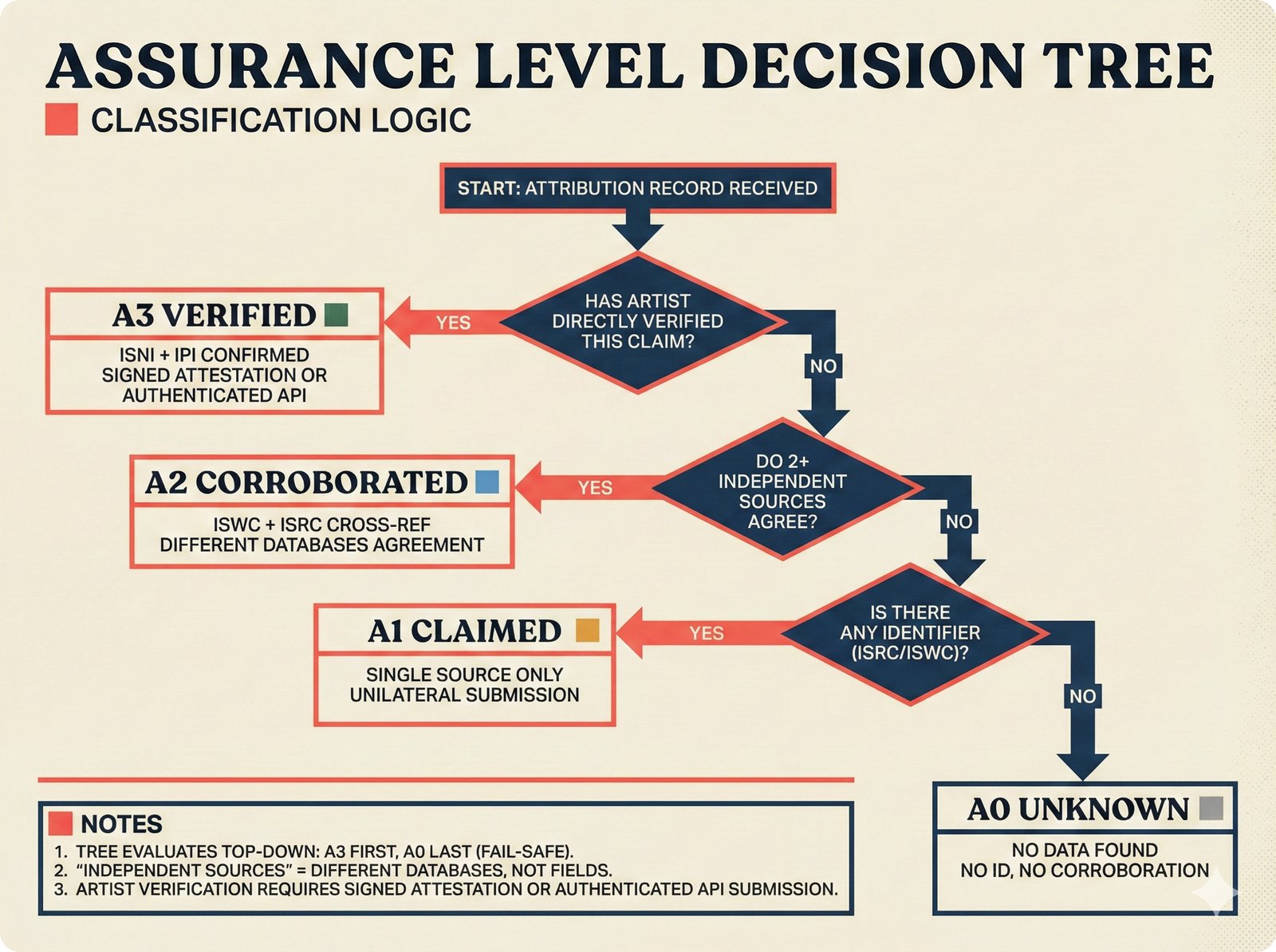
Figure 7. The assurance level decision tree evaluates top-down from A3 to A0: artist verification yields A3, cross-database agreement yields A2, any standard identifier yields A1, and absence of all evidence defaults to A0 as a fail-safe classification.
The assurance level is computed at two points in the pipeline: entity resolution and credit aggregation.
Entity Resolution (src/music_attribution/resolution/orchestrator.py):
def _compute_assurance_level(self, records: list[NormalizedRecord]) -> AssuranceLevelEnum:
    """Compute assurance level from available evidence."""
    sources = {r.source for r in records}
    has_isni = any(r.identifiers.isni for r in records)
    has_any_id = any(
        r.identifiers.isrc or r.identifiers.iswc or r.identifiers.mbid
        for r in records
    )

    if has_isni and len(sources) > 1:
        return AssuranceLevelEnum.LEVEL_3
    if len(sources) > 1 and has_any_id:
        return AssuranceLevelEnum.LEVEL_2
    if has_any_id:
        return AssuranceLevelEnum.LEVEL_1
    return AssuranceLevelEnum.LEVEL_0
Credit Aggregation (src/music_attribution/attribution/aggregator.py):
def _compute_assurance(self, entities: list[ResolvedEntity]) -> AssuranceLevelEnum:
    """Compute minimum assurance level across all contributors."""
    levels = [e.assurance_level for e in entities]
    level_order = [
        AssuranceLevelEnum.LEVEL_0,
        AssuranceLevelEnum.LEVEL_1,
        AssuranceLevelEnum.LEVEL_2,
        AssuranceLevelEnum.LEVEL_3,
    ]
    min_idx = min(level_order.index(level) for level in levels)
    return level_order[min_idx]
Conservative by Design
The aggregator takes the minimum assurance level across all contributors. If one credit in a song has A3 (verified artist) but another has A0 (unknown session musician), the overall record gets A0. This prevents a single high-assurance credit from masking gaps elsewhere.
Threshold Logic
The scaffold uses confidence thresholds from src/music_attribution/constants.py to drive review decisions:
CONFIDENCE_HIGH_THRESHOLD: float = 0.85   # Green tier
CONFIDENCE_MEDIUM_THRESHOLD: float = 0.50  # Amber tier
REVIEW_THRESHOLD: float = 0.50             # Below this -> needs_review=True
Assurance level and confidence score interact in the AttributionRecord:
graph TD
    A[AttributionRecord] --> B{confidence_score >= 0.85?}
    B -->|Yes| C[High Confidence<br/>Green tier]
    B -->|No| D{confidence_score >= 0.50?}
    D -->|Yes| E[Medium Confidence<br/>Amber tier]
    D -->|No| F[Low Confidence<br/>Red tier<br/>needs_review=True]

    A --> G{assurance_level?}
    G -->|A3| H[Forensic<br/>Identity-verified]
    G -->|A2| I[Certified<br/>Multi-source]
    G -->|A1| J[Documented<br/>Single identifier]
    G -->|A0| K[Self-declared<br/>No identifiers]

    style C fill:#e8f5e9,stroke:#2e7d32
    style E fill:#fff3e0,stroke:#e65100
    style F fill:#ffebee,stroke:#c62828
    style H fill:#e8f5e9,stroke:#2e7d32
    style I fill:#e1f5fe,stroke:#0277bd
    style J fill:#fff3e0,stroke:#e65100
    style K fill:#f5f5f5,stroke:#757575
Sample Data Distribution
The 9 Imogen Heap works in the scaffold demonstrate the full assurance spectrum:
| Work | Confidence | Assurance | Review? | Why |
|---|---|---|---|---|
| Hide and Seek | 0.95 | A3 | No | MusicBrainz + Discogs + AcoustID + artist-confirmed |
| Tiny Human | 0.91 | A3 | No | MusicBrainz + Discogs + artist self-review |
| The Moment I Said It | 0.82 | A2 | No | MusicBrainz + Discogs + file metadata agree |
| Goodnight and Go | 0.72 | A2 | No | Two sources agree, partial producer credits |
| Headlock | 0.58 | A1 | Yes | Conflicting producer credits across sources |
| What Have You Done To Me? | 0.48 | A1 | Yes | Two sources, limited cross-verification |
| Just for Now | 0.35 | A1 | Yes | Single source (MusicBrainz only) |
| 2-1 | 0.28 | A1 | Yes | File metadata only, no external verification |
| Blanket | 0.00 | A0 | Yes | No data found in any source |
Key Source Files
| File | Role |
|---|---|
src/music_attribution/schemas/enums.py |
AssuranceLevelEnum (LEVEL_0 through LEVEL_3) |
src/music_attribution/schemas/attribution.py |
Credit.assurance_level, AttributionRecord.assurance_level |
src/music_attribution/resolution/orchestrator.py |
_compute_assurance_level() logic |
src/music_attribution/attribution/aggregator.py |
_compute_assurance() minimum-across-credits logic |
src/music_attribution/constants.py |
Confidence tier thresholds |
How This Maps to Code
The assurance level flows through the entire pipeline:
- ETL collects identifiers into
IdentifierBundle(ISRC, ISWC, ISNI, MBID, etc.) - Entity Resolution computes assurance from identifier presence and source count
- Attribution Engine takes the minimum assurance across all credits
- API/MCP exposes assurance level as a first-class field on every record
- Frontend renders assurance as color-coded badges (green/blue/amber/gray for A3/A2/A1/A0)